|
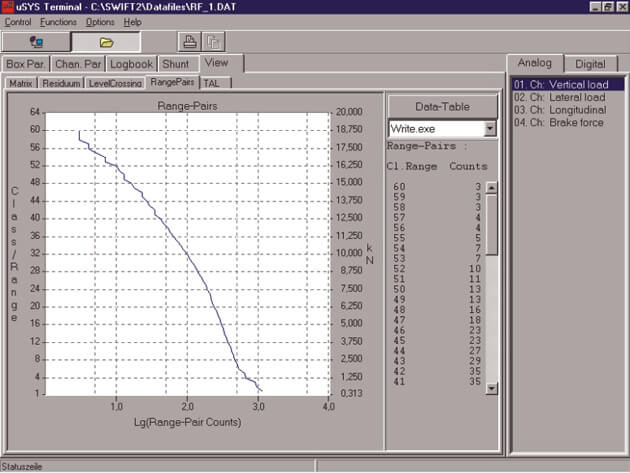
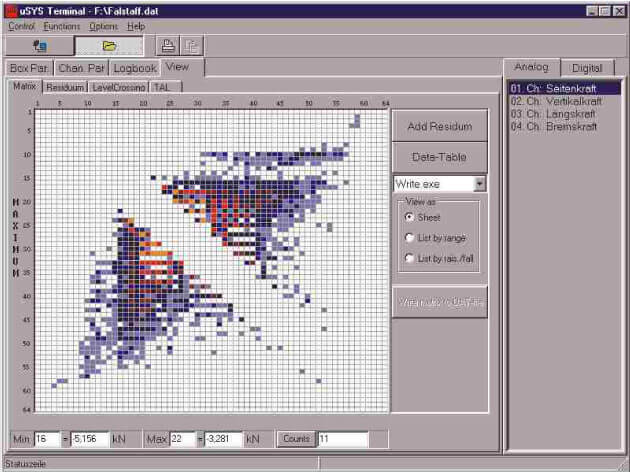
DAMCALC - Damage CalculatorFollowing the Damage Evolution software, the so-called DAMAGE Calculator is now available, too. It can carry out offline the subsequent damage calculation based on recorded rain flow matrices. This additional option allows for the individual comparison of various data records, e.g. of different test tracks or test drivers, and the impact of different climatic conditions or load
cases.
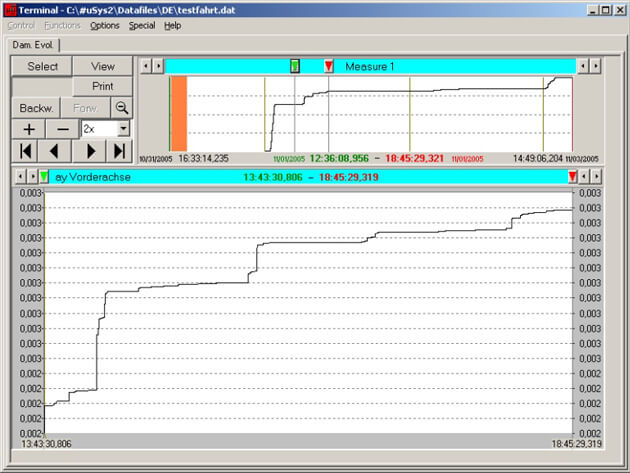
DE – Damage Evolution for RFThe Damage Evaluation method is based on the Rainflow counting and the damage calculation according to Palmgren-Miner. Based on the user defined Wöhler-line the Recorder constantly calculates the actual relative damage sum from the Rainflow matrix. The sum of damage is stored on a regular basis together with a time stamp. The demand interval can be et between 0.1 seconds or several minutes. As a result of the measurement, a curve will be generated showing the progress of the relative damage according to time. A sharp increase in the graph is equal to high damage of the vehicle. Via the time stamp these events can be correlated.
Loop ControlThis new analysis method is an external trigger for Damage Evolution.
RFX – Rainflow with variable number of classesThe Rainflow Extension RFX allows the selection of the number of classes used for the RF-classification. It supports 64x64, 128x128 and even 256x256 classes. As the required memory space increases dramatically with the number of classes this parameter can be defined for each channel individually. Thus enabling best possible memory usage.
DTCR – Direct to Card Recording
Like the method TM, DTCR is meant for the recording of signal time histories. Although, the data is not stored internally but is written directly to an inserted PCMCIA-Flash card. Cards with a size of more than 16GB are available and thus allow long term recording of signal time histories at high sampling rates with up to 2Gbyte length.
The sampling rate can be set by the user individually for each channel to a maximum rate of 2kHz per channel. The start and stop of the measurement is controlled by an external digital signal or by switching the recorder’s power supply directly.
Virtual Channel – Formel „Low Pass“This formula implements a first order digital low pass filter. The cut-off frequency of the filter and the source channel can be selected by the user. The cut-off frequency may range from 1/40 to 1/400,000 of the system sample rate. For the standard sample rate of 2kHz this results in a range of 0.005Hz to 50Hz. Because of the availability of low and very low frequencies this formula is best suited to measure the quasi static part of any dynamic value.
Extensions for the GPS-Recording Software
GPS-Slave-Channels, slave channels for GPS-Datastream
With the standard GPS-Option only the time and geographic position is stored in the GPS-Data Stream. With the Slave-Channel-Option the recorded data stream is extended by the data of one or more (up to four) freely selectable analogue channels. Typically this option is used to store route related information like engine temperature, attitude or track speed. As the set of selected slave channels is only stored once per way point the memory consumption – 2 Bytes per Channel (and way point) – is quite low.
NMEA0183-(GPS-)Analogue-Channels
With this option almost any kind of data transmitted by an NMEA0183 compatible GPS-Sensor can be filtered out of the sent NMEA0183 data stream. This NMEA0183-Channels behave like any other analogue channel and therefore can be use e.g. as trigger for TM-recording or classified according to any available evaluation method.
For instance the option can be used to get the speed over ground or the attitude without an additional sensor. In conjunction with the Option “GPS-Slave-Channel” (see above) this option can be used to extend the recorded longitude and latitude by the way points.

Detailed Overview
Please use the latest version of Adobe Reader to view our PDF files  |
|
|
|